Category: Considerations

  • The Plight of Reasonable Debate

    The Plight of Reasonable Debate

    I envy those who have so far avoided the Jubilee “Surrounded” debates which have riddled the internet for the best part of a year now. The series has amassed millions of views through its full-feature length videos and derived short-form content. At first glance, we may welcome the popularity of these videos; public discourse is an incredibly important aspect of democracy which should be encouraged. Debate allows those holding certain views to be challenged whilst granting them the opportunity to defend these views under scrutiny. Ultimately it allows both participants and observers to amend their views and convictions on the issues that matter to them. However, a closer look at Jubilee’s videos reveals a reality quite different from this ideal. Instead, the current state of internet “debate” rewards vehemently expressed extremes at the expense of reasoned discourse.

    The Cambridge Union – the oldest continuous running debating society in the world

    The most recent video of the series saw Mehdi Hasan, a well known left wing commentator, “surrounded” by 20 far-right American conservatives. However, it quickly transpired that Hasan was up against people who were, to use his own words, “a little bit more than far right republican”. One guest proudly admitted to being a fascist, an admission met with applause from others in the room, whilst another told Hasan to “get the hell out” when Hasan raised the fact that he himself was an immigrant when discussing immigration.

    About halfway through the 100 minute long video, it was abundantly clear that none of the 20 participants were there with the intention of, or perhaps even the ability to, have a reasonable debate with Hasan. One might think that Jubilee had intentionally chosen such participants in attempt to maximise jaw-dropping moments and thereby views. I personally disagree with Mehdi Hasan on many of his views ranging from taxation to illegal immigration. I would have valued seeing him truly challenged with cogent well-ariticulated arguments. More importantly, I think it would have been important for fans of Hasan to be exposed to such content. Jubilee disregarded an opportunity to improve public discourse in the US in favour of viral clips and views.

    If you are in any doubt of Jubilee’s disregard for showcasing intellectual debate, the Red Flag feature of the Surrounded format makes it unmistakably clear. If a majority of the 19 observers raise their red flags, the current debater is voted out. Most debaters are voted out within minutes. Those rewarded by the red flag system are those who score easy points by citing facts, often of doubtful authenticity, or using emotive anecdotes. Very rarely does the flag system enable a well constructed logical argument that may challenge the expert. Guests don’t want to sit through a peer defining terms or laying out coherent arguments when they themselves could be on the hot seat banging the drum.

    The problems with and popularity of Jubilee’s Surrounded format represents a much wider issue that has permeated the spirit of debate across a variety of platforms. From internet podcasts to Cambridge Union debates to motions in the House of Commons, the focus on scoring short-term points with those on one’s own side of the argument has supplanted the purpose of debate – to convince the marginal and, if effective, change the minds of the already decided.

    Countless “commentators” have risen to fame in recent years enabled by limp-lipped podcasts hosts. None I find more infuriating than Gary Stevenson, a.k.a Gary’s Economics, who travels from podcast to podcast spreading his own radical, nonsensical version of economics. Hosts like Chris Williamson and The Diary of a CEO’s Steven Bartlett podcast let him run amok whilst qualified macroeconomists cringe knowing that they would eat Gary for breakfast.1 But this is merely the tip of the iceberg when it comes to internet podcasts. The meteoric growth of the format has given way to hundreds of uninformed podcasters interviewing hundreds of unqualified guests who spread nonsense under the guise of being an expert. Dissect these podcasts into short-format clips and the internet is plagued with unchallenged rhetoric taken out of context.
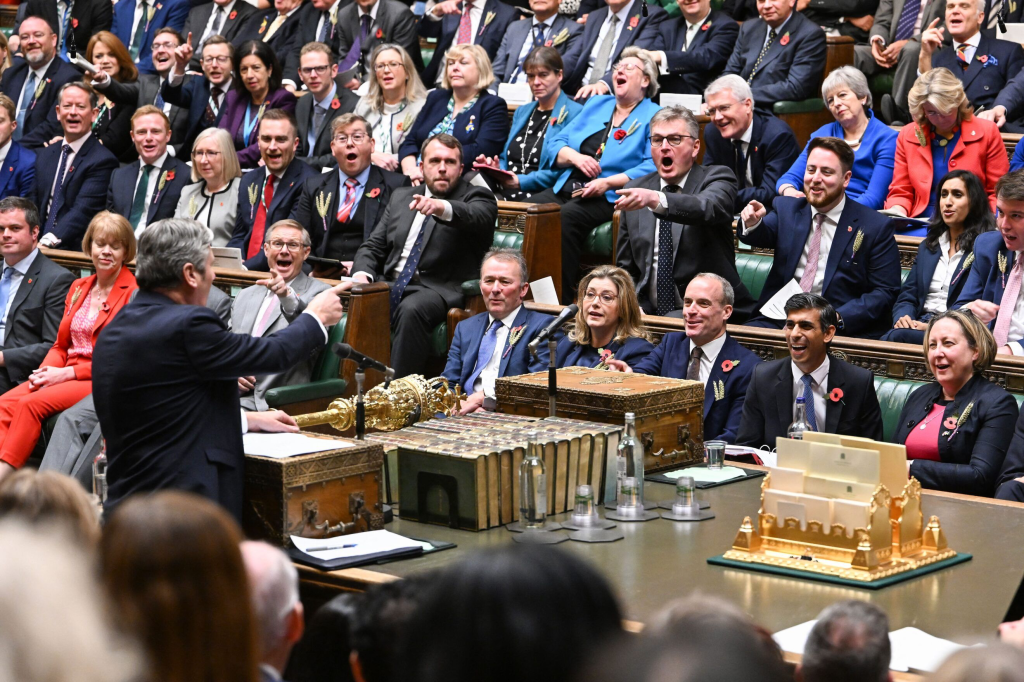
    Starmer’s first PMQs as Prime Minister

    Perhaps the most important victim of the attention-seeking debate culture has been this country’s highest form of office: the Houses of Parliament. Both houses have been broadcasted to the public since the 1980’s. Unsurprisingly, PMQs is the most popular item of the week. Party politics has always been the name of the game at PMQs but never to the extent it is today where the content of PMQs seems irrelevant – what matters is if The Telegraph considers Kemi to have silenced Starmer or fallen flat in the following morning’s paper. Increasingly this is not determined by cogent argument but whether the Leader of the Opposition can berate the Prime Minister for his failings whilst amply deflecting the return fire. Those who supported televising Parliament in the 1980s could not have anticipated the harm it might cause in today’s politically polarised, internet-driven world; 40 years on, I am certain it was a mistake.

    A strong atmosphere of public discourse is essential for a well functioning democracy. We often underestimate how much online debates shape the conversations we have in person. I will admit that the majority of arguments I make in conversation are not originally my own but taken from an article I have read, a debate I have watched or a conversation I have had with someone else. Good arguments spread exponentially whilst bad ones fall by the wayside. An absence of quality arguments in the media threatens to nip this process in the bud; if intelligent arguments are replaced by derisive rhetoric, polarisation is inevitable. Although this is an artefact of modern media, it is not an inescapable one. We must look past the YouTube main page for political content and beyond Instagram feeds for news. Instead read newspaper and magazine articles in their totality, seek out podcasters and guests who are well researched and qualified, and reward content creators that are in search of true debate rather than viral moments.2 Once a process of rewarding intellectual discourse begins, we may hope to escape the race to the bottom we currently find ourselves in.

    1. Maybe I will write a post trying to eat Gary for breakfast. ↩︎
    2. I hope you might find examples of such content in my Further Reading page. ↩︎
  • Reframing Umpire’s Call

    Reframing Umpire’s Call

    This Monday I was lucky enough to watch a spectacular day of Test cricket at Lord’s. Having bought a last-minute ticket on a whim, I was treated to the finale of a five-day nail-biter. The match had everything one would hope for in a Test; marvelous batting, glorious bowling, and a fierce rivalry underpinning the contest which elevated all aspects of the game to the highest level. The match undoubtedly deserves to be remembered as an “absolute classic” – an accolade sparingly bestowed in a format where matches are sadly becoming few and far between. I do hope that this match reignites passions for the long format game; as Sir Geoffrey Boycott put it in a voice note for the Telegraph in his characteristic Yorkshire accent, “T20 can be fun but it has nothing on Test match cricket at its best”.

    No need for Umpire’s Call here as Archer skittles Pant

    I had all the time in the world to watch days 1-4 on TV pending my trip to Lord’s. Sitting with Suetonius’s The Twelve Caesars in hand, I probably watched 80% of deliveries on these days. Safe to say I didn’t progress far into the classical epic I had prescribed myself to finish before Sunday evening; I only made it to the end of the chapter on Augustus, who you may know was only The Second Caesar. Despite this, I feel that I used my unique inoccupation wisely. The last time I watched a Test match so fixatedly was the summer of 2011. I vividly remember sweltering in my grandparents’ home in Mt Lavinia, Sri Lanka, watching Alistair Cook knock 294 against India at Edgbaston. I even remember his dismal dismissal: lofting one to Suresh Raina at deep point, having not hit a single six in his 545-ball innings.

    Test cricket has evolved significantly since 2011, one often forgotten evolution being the implementation of the Umpire’s Call rule.1 The rule has been prolific in the Anderson-Tendulkar series so far, coming into play eight times in the first three tests. At Lord’s, on-field decisions were upheld on three occasions by Umpire’s Call. This has thrust the rule into the limelight sparking conversation with some muddled takes. Perhaps we can blame the emotion involved in Test match cricket, but nearly a decade on from the ICC’s implementation of Umpire’s Call in 2016, it is time that players, commentators and spectators think deeply about the rule.

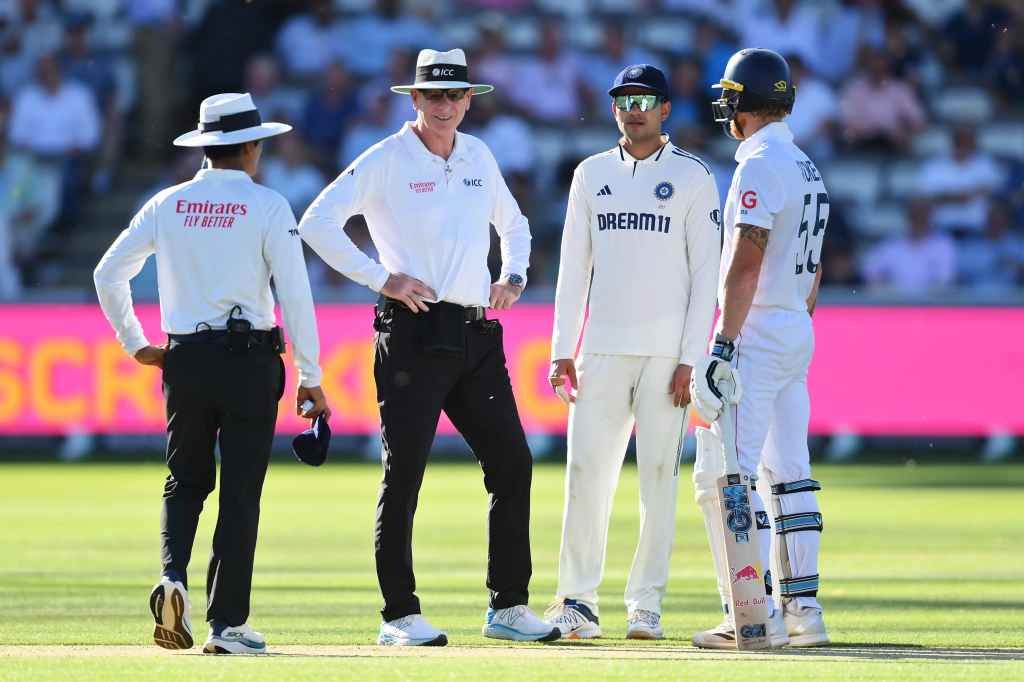
    Paul Reiffel (second from left) had three reviews upheld by the Umpire’s Call rule at Lord’s, two going against India on key wickets Root and Stokes.

    Let’s consider one recent comment from which we might identify where the misunderstandings lie. Indian batting legend Sunil Gavaskar was commentating when Joe Root wasn’t given out on-field and the decision remained upon review when ball tracking suggested that it was Umpire’s Call. He said from the commentary box, “You’re saying it was going to kiss the leg stump? There’s no way. It was knocking the leg stump off. The only good thing is that India has not lost the review.”

    There’s a lot to unpack here but it might be prudent to start with why Umpire’s Call was first introduced in 2016. There are errors involved with all prediction methods and technology.2 Once the ball has hit the pad, ball tracking is no longer doing what is says on the tin – instead it has now turned from tracking to predicting. Every instance of ball prediction, as I will now call it, has some distribution with associated error. When we are shown on the big screen the flight of the ball after it hits the pad, we are being shown the mean prediction. There are a range of other possible flights that could have happened with some probability.

    We can think about this with a simple example in which we abstract away the height of the ball and instead focus purely on line. Consider a scenario in which the ball prediction system is 70% certain that the ball would have hit middle stump and 95% certain it would have hit any of the stumps. Assuming symmetry, this gives a 2.5% chance that the ball would have missed leg and a 2.5% chance that the ball would have missed off. In this scenario, it seems reasonable to give the batsman out – we can say with 95% confidence that the ball was going on to hit the stumps. Now transpose this scenario onto the off stump. Now there is a 70% that the ball would have hit the off stump, and less than 15% chance that it would have hit middle or leg. This leaves a 15% chance that the ball would have missed off. Now it seems less reasonable to give the batsman out – we can now only say with 85% confidence (at most) that the ball was hitting the stumps.

    If we move the mean prediction around, we can see that at some point it changes from it being reasonable to unreasonable to give someone out off of the ball prediction (given some threshold confidence you want to have i.e. 95%). Umpire’s Call was introduced because the ICC decided that the point at which the mean prediction switches from being reasonable to unreasonable, crossing their chosen confidence threshold for LBW decisions, is when exactly half of the ball is predicted to hit the stumps. They decided that when less than half of the ball was hitting the stumps, the Umpire’s decision was to be trusted – the ICC had more confidence in the Umpire to predict the flight of the ball at this point than the ball prediction system. Hence, we have Umpire’s Call.

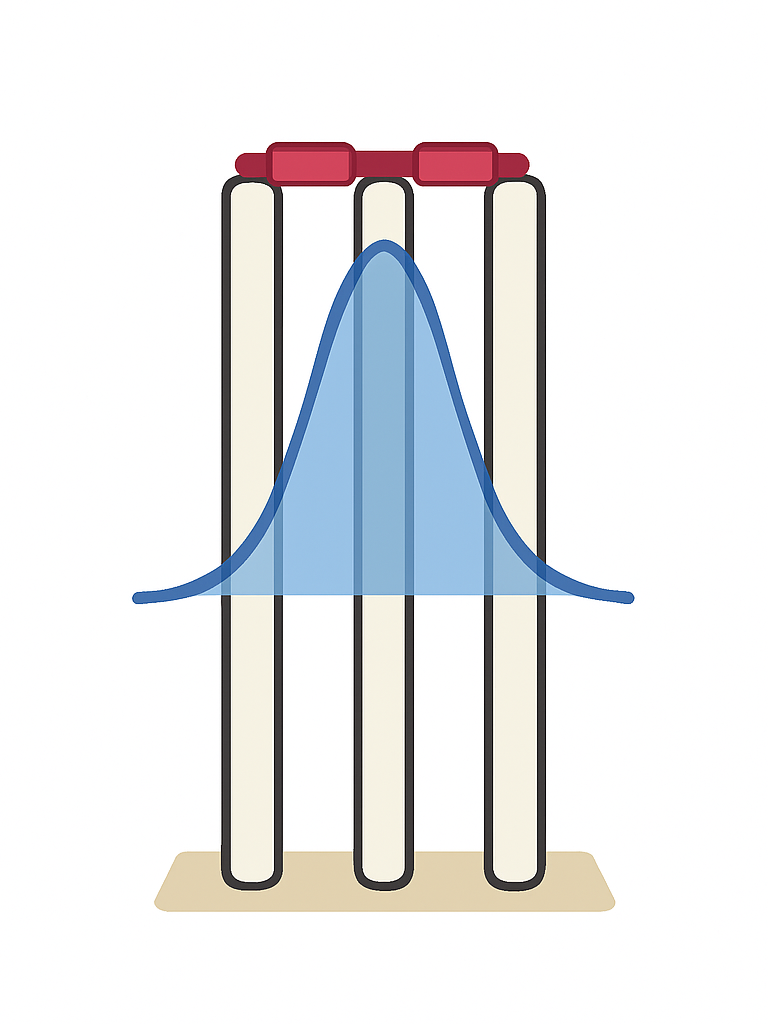
    Let the distribution be the predicted impact of the ball on the stumps and visualise moving the mean (centre) of the distribution horizontally.

    Now let’s return to Gavaskar’s comments on Root’s survival by Umpire’s Call. Saying that there was no way a ball was going on to kiss leg stump but was instead going to hit leg plumb indicates a misunderstanding of how Umpire’s Call works. The whole point is that if the ball prediction system predicts that it was kissing leg, we can’t trust it so we defer to the on-field umpire. In this instance the on-field umpire thought it was missing, Gavaskar thought it was hitting; a more appropriate thing to say in the commentary box would be “the Umpire thinks it was going to miss leg stump? No way. It was knocking the leg stump off”. His quibble shouldn’t be directed at DRS, nor Umpire’s Call – rather it should be directed at Paul Reiffel.

    Umpire’s Call has played a key role in the Test series between India and England creating frustrating moments for both sides. Commentators must do a better job of conveying to spectators that a deferral to Umpire’s Call is not an arbitrary decision to stand behind umpires but rather one that aims to improve the accuracy of in-game decisions. There exist an abundance of reasons why Test cricket is dying, but one wholly avoidable factor is the perceived highbrow nature of the sport, with its esoteric rules and terminology. We have to minimize this sentiment if we want the format to thrive. Comments like Gavaskar’s, for example, just muddy the waters for spectators new to the game. A large part of the problem with Umpire’s Call has to do with the on-screen DRS graphics that spectators see during a review. The easiest way to explain to someone new to the game what to look for during a review is three reds. I never know where to begin the moment an orange box appears and the inevitable question follows: “Wait — why isn’t that out?”

    1. The LBW rule essentially states that a batsman can be given out if the ball strikes their legs and would have otherwise gone on to hit the stumps. DRS allows both the batting and fielding sides to challenge the on-field umpire’s decision using ball-tracking technology. Before the introduction of Umpire’s Call in 2016, if any part of the ball was hitting the stumps, the batsman would be given out. After the introduction of Umpire’s Call, what mattered was the centre of the spherically modelled ball. If the centre of the ball was hitting the stumps, then the batsman would be given out. If the centre was outside of the rectangle area of the stumps, technically called the Wicket Zone, meaning less than half the ball was within the rectangle, the original decision of the on-field umpire would remain. ↩︎
    2. This includes the ball flight prediction an on-field umpire does when making an on-field decision. ↩︎

  • Thoughts on Risk thanks to Howard Marks

    Thoughts on Risk thanks to Howard Marks

    I recently read Howard Marks’s book The Most Important Thing. For the uninitiated, Marks is a co-founder and co-chairman of Oaktree Capital Management, the world’s largest distressed debt investment firm. He is known for his memos which are posted publicly on the Oaktree website in which he discusses investment insights, investing strategies and the economy. Amongst his list of accolades, potentially the most notable is a very public endorsement by Warren Buffet who has said “when I see memos from Howard Marks in my mail, they’re the first thing I open and read”. He also happens to have a net worth of c. $2.2 billion. It’s therefore unsurprising that Marks’s book is full of investment gems; it is almost certainly the best book on investing I have read.

    Howard Marks, co-founder of Oaktree Capital Management

    Marks’s approach to risk is intuitive and simple, and for me the highlight of his book. It is, however, unorthodox; it differs fundamentally from the notion of risk that many of us (myself included) have been indoctrinated with in undergraduate and graduate finance classes. And the divergence from theoretical financial models is welcome; if understood, Marks’s approach to risk provides actionable investing insight.

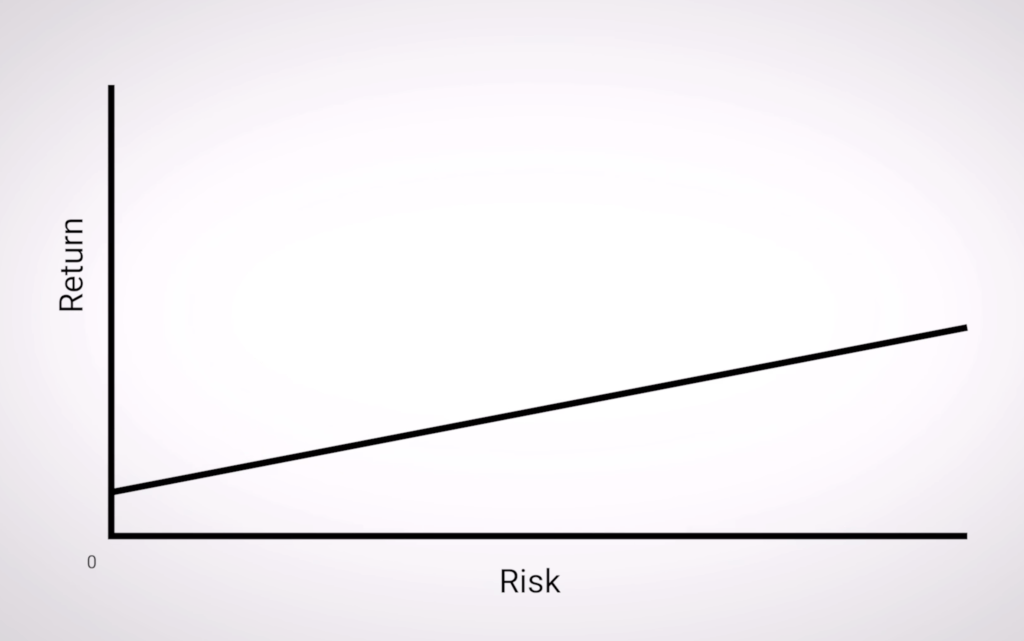
    To understand it, we must consider the fundamental relationship in investing: that between risk and return. For an investor to be willing to take on more risk, he must be enticed by more return. Consider the choice between two assets, A and B. A and B both have equal returns but A is riskier than B. We would of course choose to invest in B. This is driven by the fact that we dislike risk; in economic jargon we are risk averse.

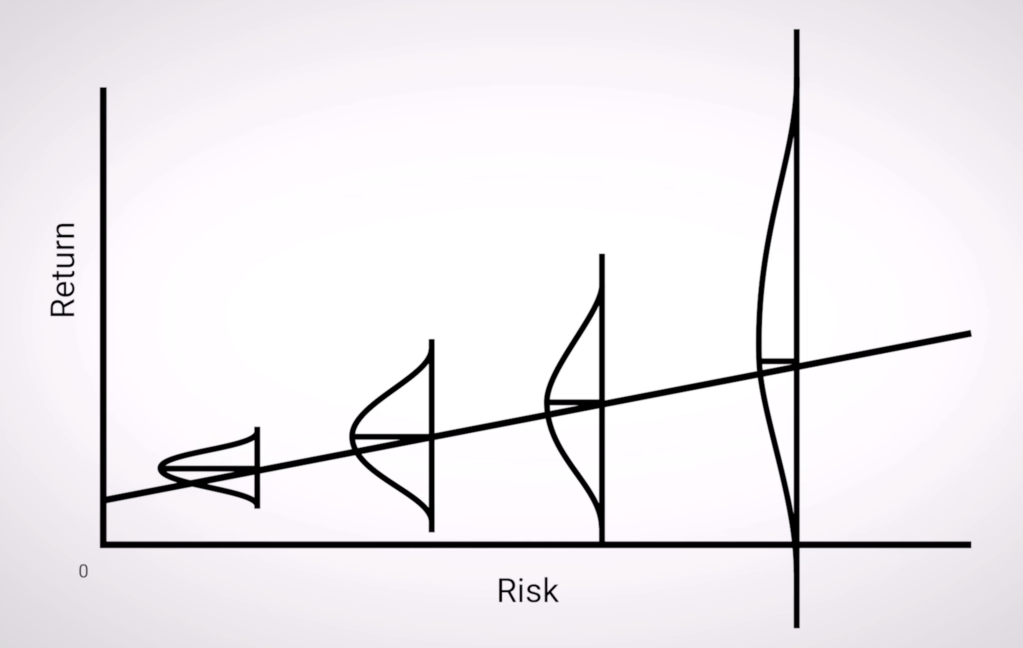
    Can you spot the cardinal misnomer I’ve committed in the last paragraph? In place of where I should have said expected returns I’ve instead referred to returns. I misrepresented something which is stochastic as deterministic. More risk doesn’t guarantee higher returns – it just means we can expect higher returns. To quote Marks “there is nothing to say that those higher returns have to materialize”. This is an important idea and can be captured by thinking of the capital market line as in Figure 2 instead of Figure 1.

    Figure 1: Looks deterministic
    Figure 2: But it’s actually stochastic

    So far we cannot fault the theory. Finance professors are careful to include expectation symbols before returns in their capital market model derivations. The notion of risk, however, has suffered from simplification to the extent that a layperson’s understanding of risk closely rivals that of a Masters in Finance student entering the asset management industry.

    Risk is measured in the theory as variance of returns, Var(R). Variance simply measures the spread of returns and gives academics an easy number to work with. But spread of returns (a.k.a volatility) isn’t really what people think about when they refer to risk. If it is, it isn’t what they mean deep down. Investors don’t demand higher returns from an asset just because it has a higher spread of returns. A higher spread could be biased to higher returns, it could be biased to lower returns. This can be visualised by adding skewness to the vertical distributions in Figure 2. It is clear that the direction of such bias (which we can measure with second order moment, kurtosis) is what investors really care about.1 They demand higher returns because they risk losing money.2 This is what truly drives the risk-return relationship.

    Now the final point about risk made by Marks, which I believe is somewhat understated in his book, is that the extent to which investors dislike risk (i.e. their degree of risk aversion) is not static. This is contrary to the assumption often made in financial theory. Marks emphasises that risk aversion varies throughout time and in coordination with the boom-bust cycle. The investment cycle, like the business cycle, is characterised by booms and busts. In the boom phase of a cycle, investors may not demand as much expected return to take on X amount of risk. In other words, their risk aversion is low. In contrast, during a bust investors will demand a higher expected returns to take on the same X amount of risk – risk aversion is high. We can visualise this using the capital market line: the higher investors’ risk aversion, the steeper the capital market line will be. The lower the risk aversion, the shallower the capital market line will be.3 This phenomenon, he believes, provides opportunities for the enlightened investor.

    During a bust, varying risk aversion means that rising fear widens risk premiums at the same time that most investors de-risk their portfolios. Marks calls this the “perversity of risk”. The prudent investor would instead add risk to their portfolio when others are de-risking because the premium for doing so is currently high. Again quoting Marks, “when everyone believes something is risky, their unwillingness to buy usually reduces its price to the point where it’s not risky at all”. This, to me, is the one most important piece of investing advice in his book.

    When a friend pointed me towards Marks’s book, I took his recommendation, but with a pinch of salt. I said “I do occasionally think that there is no point reading books by people who have done well in finance, especially investing. Because what part of their success is down to being on the far right tail of the distribution by chance”. I was therefore delighted when I found out that chapter 16 of The Most Important Thing is entitled Appreciating the Role of Luck. And for Marks, the proof is in the pudding; Oaktree’s investments in distressed debt in Q4 of 2008 yielded 50-100% in the subsequent 18 months. This is the exact type of trade mentioned above. Marks has talked the talk and walked the walk – a rare thing in the world of finance. I cannot recommend his work enough.

    1. More astute readers will recognise that this doesn’t stop at second order moments. Even higher order moments are important but the intuition becomes difficult (and superfluous) beyond the second. ↩︎
    2. I point readers towards semi-variance and the Sortino ratio to measure the risk of loss. ↩︎
    3. You may also want to think about the intercept of the capital market line with the return axis – the expected return when we don’t take on any risk. This can also change throughout the cycle. This is important but surplus to requirements in the context of this post. ↩︎